AdLibris Letto Frontlight: Sweden’s Secretly French Reader
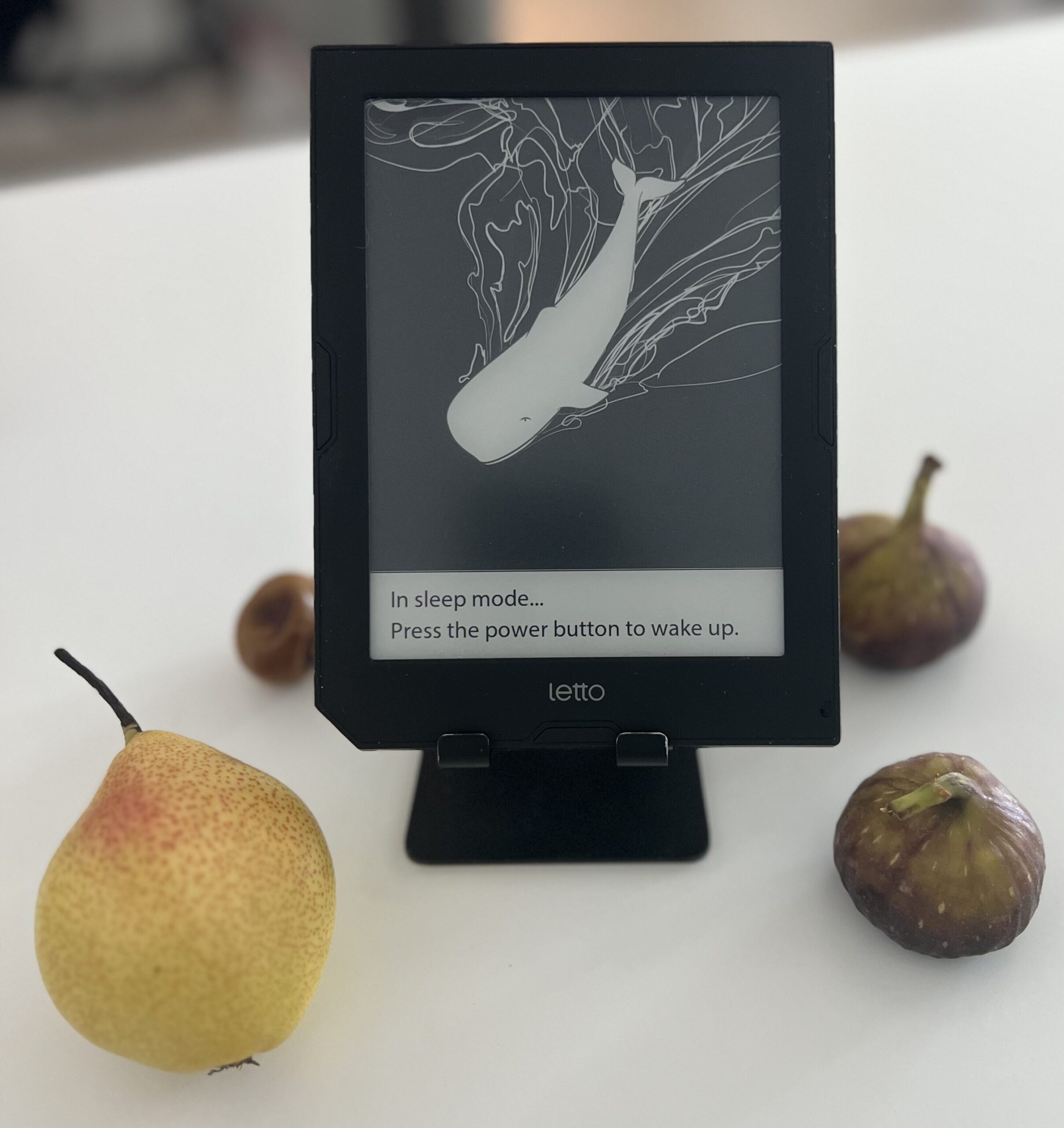
There is a whale on the screen.
Not a Swedish whale, as it turns out. That sleeping whale — tangled in what looks like seaweed drawn by someone who was enjoying themselves — is a Bookeen whale. Bookeen is French. The device it is swimming inside says letto on the chin, and letto is AdLibris, and AdLibris is Sweden’s largest online bookshop, owned by Bonnier, the publishing house that has been Swedish since 1804. Hence – the AdLibris Letto Frontlight
So: a Swedish bookshop’s e-reader, running French firmware, with an Italian-sounding name (letto means “read” in Italian, and also “bed”, which is either a lovely pun about where people actually read or a happy accident nobody at AdLibris has ever confirmed).
Welcome to the strange, largely forgotten world of bookseller-branded e-readers.
What it actually is
Underneath the Swedish paint, the AdLibris Letto Frontlight is a Bookeen Cybook Muse Frontlight. Bookeen is one of the oldest names in e-ink — they descend from Cytale, who shipped a reading device in 2001, four full years before the first Sony Librié and six before the Kindle. When the e-reader wars arrived, Bookeen did what small clever companies do: they stopped fighting for shelf space and started selling their hardware to other people who wanted an e-reader with their own logo on it.
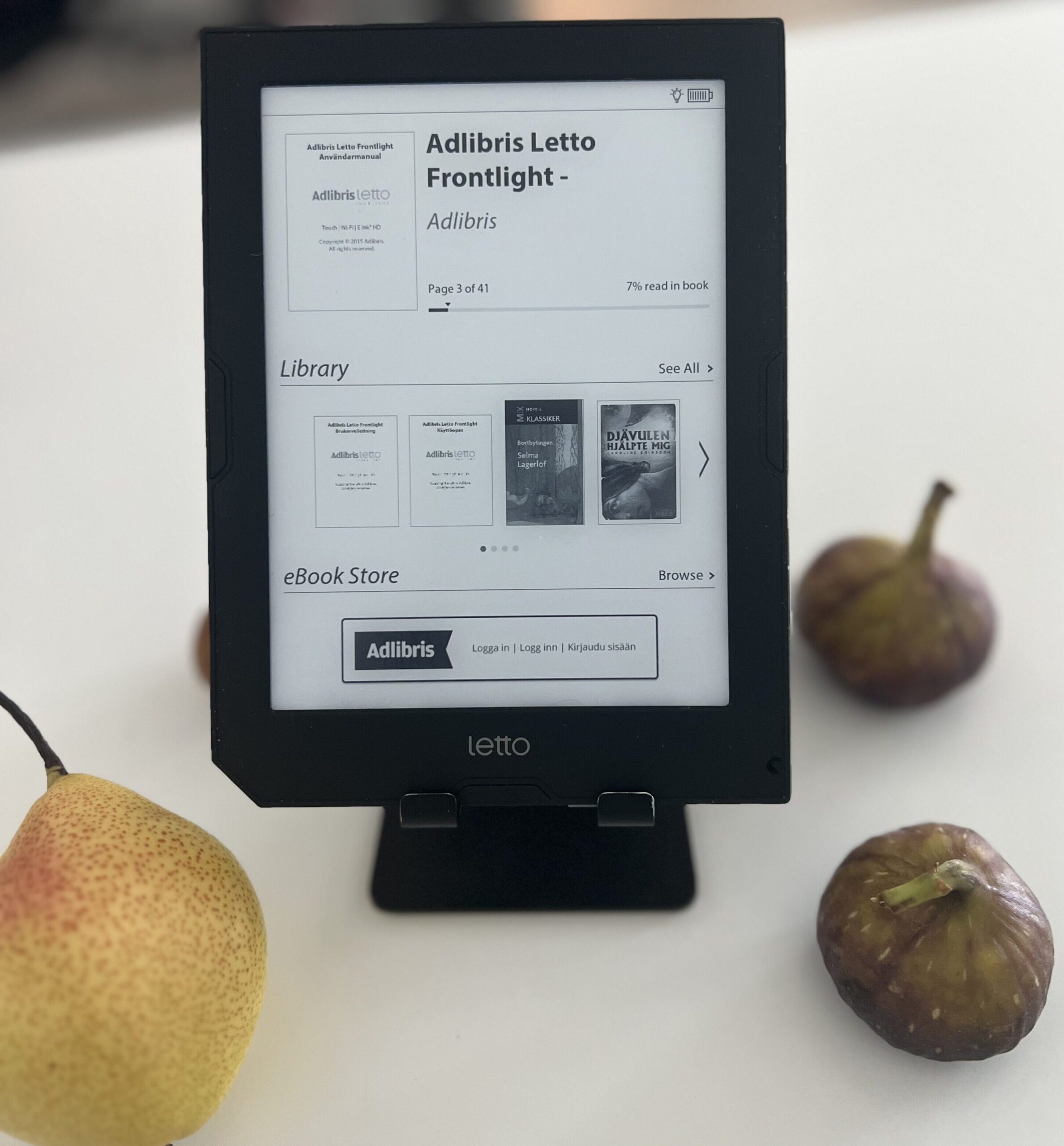
AdLibris was one of those people. They launched the Letto Frontlight at 995 kronor (approximately $105 USD), loaded it with their own bookstore, made it speak Swedish, and pointed it squarely at Swedish readers who wanted books in their own language without going through Seattle.
Look at the photograph and you can read the whole design philosophy off the bezel. There are physical page-turn buttons on both edges — proper recessed rockers, not capacitive pretend-buttons — which means the thing was designed by people who had watched someone read in bed and noticed which hand they were using. The frame is chunky by 2026 standards. The chin is deep. It looks, honestly, a bit like a Kobo Glo that had been left out in the rain, and I mean that with affection.
Specifications
| Screen | 6″ e-ink, front-lit |
| Resolution | 212 dpi (the later 3 HD went to 300 dpi) |
| Page turns | Physical buttons, both edges, plus touch |
| Base hardware | Bookeen Cybook Muse Frontlight |
| Store | AdLibris, Swedish catalogue |
| Library books | Yes — Swedish library loans supported |
| Launch price | 995 SEK |
The line ran to at least three generations. The Letto Frontlight 2 added a shock-resistant silicone case with a magnetically-attached cover, which is a very sensible thing to add and a very boring thing to announce. The Letto Frontlight 3 and 3 HD arrived later, the HD version finally reaching 300 dpi against the 212 dpi of the standard — the same resolution jump the Kindle Paperwhite had made years earlier.
The bit nobody mentions
Swedish reviewers were not universally kind. The complaints that come up repeatedly are battery life and software stability — the device would sometimes need a reset, and the promised weeks of reading were, in practice, rather fewer weeks.
This is worth sitting with, because it is the recurring disease of the rebadged e-reader. You are buying hardware from one company, firmware from a second, and a bookstore from a third, and when something goes wrong nobody quite owns it. Amazon’s great advantage was never the screen. It was that when your Kindle misbehaved, exactly one company was responsible.
Bookseller e-readers: a small graveyard
Here is the part that makes this device more interesting than its spec sheet deserves.
Between roughly 2010 and 2016, nearly every serious bookseller in the world decided it needed its own e-reader. Not because they wanted to be in hardware — nobody at a bookshop wakes up wanting to be in hardware — but because Amazon was eating their business and the device was the doorway.
- Barnes & Noble built the Nook. Real engineering, real money, genuinely good hardware. Now a shadow.
- AdLibris rebadged a Bookeen and called it Letto.
- Waterstones in the UK gave up entirely and sold Kindles in their shops, which is either pragmatism or surrender depending on how you feel about it.
- Tolino — and this is the interesting one — was not a bookseller. It was all of them at once. Thalia, Weltbild, Hugendubel, Club Bertelsmann and Deutsche Telekom pooled their weight into a single platform.
Guess which one is still alive.
Tolino survived because it stopped being a shop’s e-reader and became an industry’s e-reader. Everyone else tried to fight Amazon alone, on Amazon’s terms, with a fraction of Amazon’s engineering budget, and lost in the way you would expect. If you want the fuller version of that story, it is sitting on our Tolino page — Tolino is genuinely under-covered in English and is the only surviving answer to the question the Letto was asking.
Should you buy one?
Almost certainly not. Let me be plain about it.
A Letto Frontlight in 2026 is a 212 dpi screen with uncertain battery health, tied to a Swedish bookstore account, running firmware nobody has updated in years. If you want to read books, essentially any Kobo from the last five years will be better in every measurable way, and it will borrow from your library natively.
Buy one if: you read Swedish and already have an AdLibris library you want to keep reachable · you collect odd e-ink hardware · you like the idea of owning a French device wearing Swedish clothes · you want physical page buttons and you want them cheap.
Do not buy one if: you want this to be your only e-reader.
If it is the physical buttons you are after — and that is a completely legitimate reason to go hunting through old hardware — the modern answer is a Kobo Libra or a Kindle Oasis, both of which do the thing the Letto did, with a screen from this decade. Our used e-reader guide covers what to check before you hand over money for any second-hand unit, and the library borrowing page explains why Kobo beats Kindle at the thing the Letto was originally built to do.
Where to find one
These surface almost exclusively on Swedish and Nordic listings — Blocket and Tradera domestically, occasionally eBay when someone in Stockholm decides to ship internationally. Search “Letto Frontlight” rather than “AdLibris”, since the AdLibris name pulls in thousands of book listings and drowns the device entirely.
Check the front light before you buy. It is the component that fails first on devices of this vintage, and a Letto without its frontlight is just a Letto.
Questions people actually ask
Is the Letto Frontlight the same as a Bookeen Cybook Muse?
Effectively yes. Same hardware, AdLibris firmware and store on top. If you find Bookeen Cybook Muse Frontlight documentation, it applies.
Can it read EPUB files I already own?
Yes. This is a Bookeen device and Bookeen has always been EPUB-friendly. Sideloading over USB works.
Does the AdLibris store still work?
Treat this as unknown and verify before you buy. Bookseller-run e-reader stores have a poor track record of staying online, and a Letto whose store has gone dark is a sideloading-only device — which is fine, as long as you knew that going in.
What is the difference between the Frontlight, the 2, and the 3?
The 2 added the silicone shock case and magnetic cover. The 3 came in two versions, and the 3 HD is the one you want — 300 dpi against 212 dpi on everything before it.
This is one of the odd ones. If you own something stranger, we would like to see it — the Miscellaneous E-Readers section exists precisely for devices the rest of the internet forgot.
Disclosure: we earn a commission if you buy through links on this page. It costs you nothing and it keeps the lights on.