Tolino Vision 2: Waterproof, With a Large Asterisk
/
Do not confuse this device with the Tolino Vision 4 HD, a much later model that actually earned an unambiguous IP rating. The Vision 2 is older, from 2014, and its water-resistance story is genuinely murkier than either the marketing or a quick skim of specs would suggest — which makes it more interesting than a simple waterproof/not-waterproof label would let on.
Here’s the odd part. Tolino’s own alliance announced the Vision 2 as “a waterproof e-reader,” and the underlying technology — a nanocoating from a company called HZO, sealing the internals against moisture — carried a claimed rating equivalent to IP67/IPX7. That sounds definitive. But Good e-Reader’s contemporary hands-on coverage pushed back the same week, arguing the device was being “billed” as waterproof but was really better described as splash-resistant, largely because the Micro USB port had no protective flap. German Wikipedia’s technical entry lands somewhere in between: wassergeschützt, aber nicht wasserdicht — water-protected, but not waterproof. Water can get in and drain back out without damaging the device, which is a real, useful property, and also not the same claim as full waterproofing.
So: three sources, three shades of the same story. That contradiction is worth reporting honestly rather than flattening into a single confident line either way.
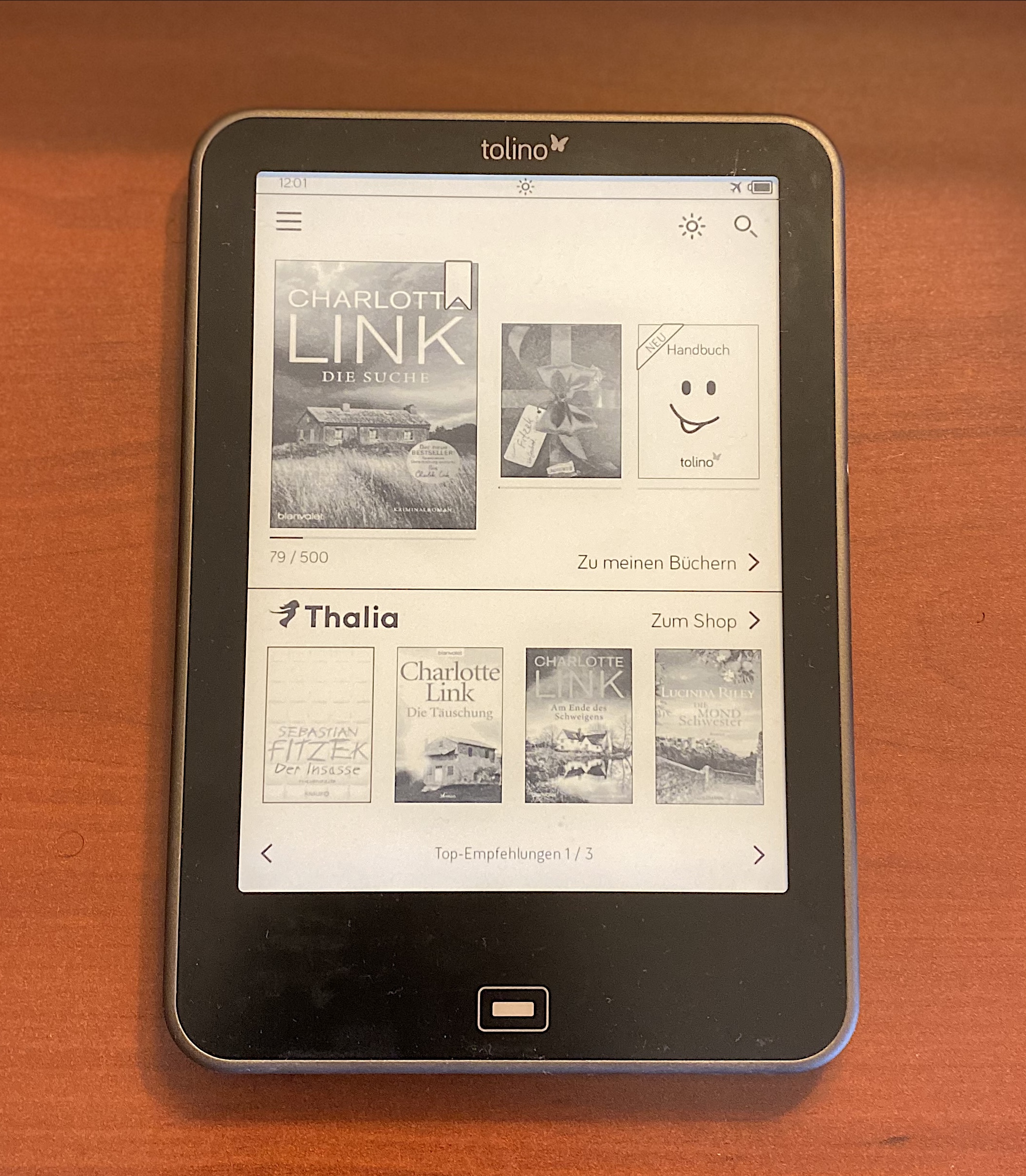
What it actually is
Tolino is not a single company but an alliance — Thalia, Weltbild, Hugendubel, Club Bertelsmann and Deutsche Telekom banding together in 2013 to build a shared e-reader platform as a counterweight to Amazon in the German market. The Vision 2, released in 2014, was the alliance’s second Vision-line device and the first to add water protection and a party trick called tap2flip.
Specifications
| Screen | 6″ E Ink Carta HD, capacitive touch, front-lit |
| Resolution | 1024 × 758, 213 ppi |
| Water protection | HZO nanocoating, claimed IP67/IPX7 equivalent — see caveats above |
| Processor | Freescale i.MX6, 1 GHz |
| RAM | 512 MB |
| Storage | 4 GB internal (roughly 2 GB usable), no microSD expansion |
| Battery | 1500 mAh, claimed ~7 weeks |
| Connectivity | Wi-Fi 802.11 b/g/n, Micro USB |
| Dimensions | 163 × 114 × 8.1 mm |
| Weight | 174 g |
| Formats | EPUB, PDF, TXT (with and without DRM) |
Two things worth flagging directly from the specs. First, the Vision 2 dropped the microSD slot its predecessor had — a genuine step back in expandability, traded for the sealed casing the water protection required. Second, that same sealing made the device harder to repair: HZO’s coating and the sealing of internal connectors made component swaps, including battery replacement, more difficult than on an unsealed device.
The tap2flip feature
This is the device’s other real oddity. A shock sensor on the back panel lets you turn pages by tapping the rear of the device — no touching the screen, no button. It’s calibrated with a fairly high trigger pressure and a built-in delay to avoid accidental page turns from ordinary handling, and it can be switched off. It only turns pages forward; there’s no back-flip or menu access through the same gesture. Protective covers made for the Vision 2 had to leave the back panel open specifically so tap2flip kept working. It’s a genuinely clever, slightly gimmicky feature that nobody else really copied, which is exactly the kind of dead-end innovation this whole series of articles exists to document.
What it’s actually like to use — and what’s wrong with it
The Carta HD screen at 213 ppi was a strong panel for 2014 — the same generation of e-ink used in the Kindle Paperwhite 2 and Kobo Aura H2O, per period reporting, and it renders text cleanly with decent contrast. The device did well in contemporary reviews too: Stiftung Warentest, Germany’s leading consumer-testing body, rated it “Sehr Gut” (1.5) in a comparison of Adobe-compatible e-readers, and independent German outlets scored it similarly.
Set against that: the loss of microSD expansion is a real regression from the previous Vision, the sealed casing complicates any future repair, and the water-resistance claim — genuinely useful for a splash or accidental drop into a sink — should not be trusted with anything approaching real submersion given the exposed USB port. Treat “water-protected” as the accurate phrase and “waterproof” as marketing rounding up.
Who should buy one now, if anyone
Nobody should buy a Vision 2 today expecting genuine waterproofing for pool or beach use — that promise belongs to the later Vision 4 HD, which carried an unambiguous, tested IP rating, not the contested nanocoating claim on this model.
Buy one if: you want a well-regarded, well-built 2014-era e-reader with a genuinely good screen for its time and don’t care about microSD expansion · the tap2flip gimmick specifically interests you as a piece of e-reader history · you read German and want access to the Tolino ecosystem’s German-language store.
Do not buy one if: you want reliable water resistance, expandable storage, or current-generation speed. For water resistance specifically, look at a genuinely IP-rated modern device rather than this one. For Tolino’s current, considerably improved lineup generally, our Tolino hub covers what the alliance sells today and how it stacks up against Kobo.
If library ebook lending through your local library system matters to you, note that Tolino devices are built around the German library ecosystem specifically — our library ebooks guide covers how that compares to Kobo’s OverDrive/Libby integration for English-language borrowers.
Where to find one
The Vision 2 turns up on eBay, mostly from German and wider European sellers, consistent with its origin as a German-market device. Given its age, ask specifically about battery condition and whether the water-sealing has ever been compromised by a drop or repair attempt — a Vision 2 that’s been opened loses the integrity of its original nanocoating.
Questions people actually ask
Was the Tolino Vision 2 actually waterproof?
This is genuinely contested. Tolino marketed it as waterproof, and HZO’s nanocoating carried a claimed IP67/IPX7-equivalent rating. Contemporary reviewers at Good e-Reader and Tolino’s own German Wikipedia entry describe it more cautiously — water-protected against splashes and brief exposure, not confirmed safe for full submersion, particularly given the unsealed Micro USB port. Treat it as splash-resistant, not pool-ready.
Is the Vision 2 the same as the Vision 4 HD?
No — the Vision 4 HD is a later, separate model with its own confirmed IP rating. Don’t conflate the two when shopping.
Does it have microSD expansion?
No. The Vision 2 dropped the microSD slot present on the original Vision, trading it for the sealed water-protective casing.
What is tap2flip?
A shock-sensor feature that turns pages forward when you tap the back of the device, with a delay mechanism to prevent accidental triggers. It can be disabled and doesn’t support backward navigation.
Sources: German Wikipedia: Tolino Vision 2; Good e-Reader, “Waterproof Tolino Vision 2 Unveiled,” contemporary 2014 hands-on; HZO press release on the water-protection technology. The waterproofing claim is presented with the contradiction intact, per the available sources — no single source fully resolves it.
This is one of the odd ones. If you own something stranger, we would like to see it — the Miscellaneous E-Readers section exists precisely for devices the rest of the internet forgot.
Disclosure: we earn a commission if you buy through links on this page. It costs you nothing and it keeps the lights on.